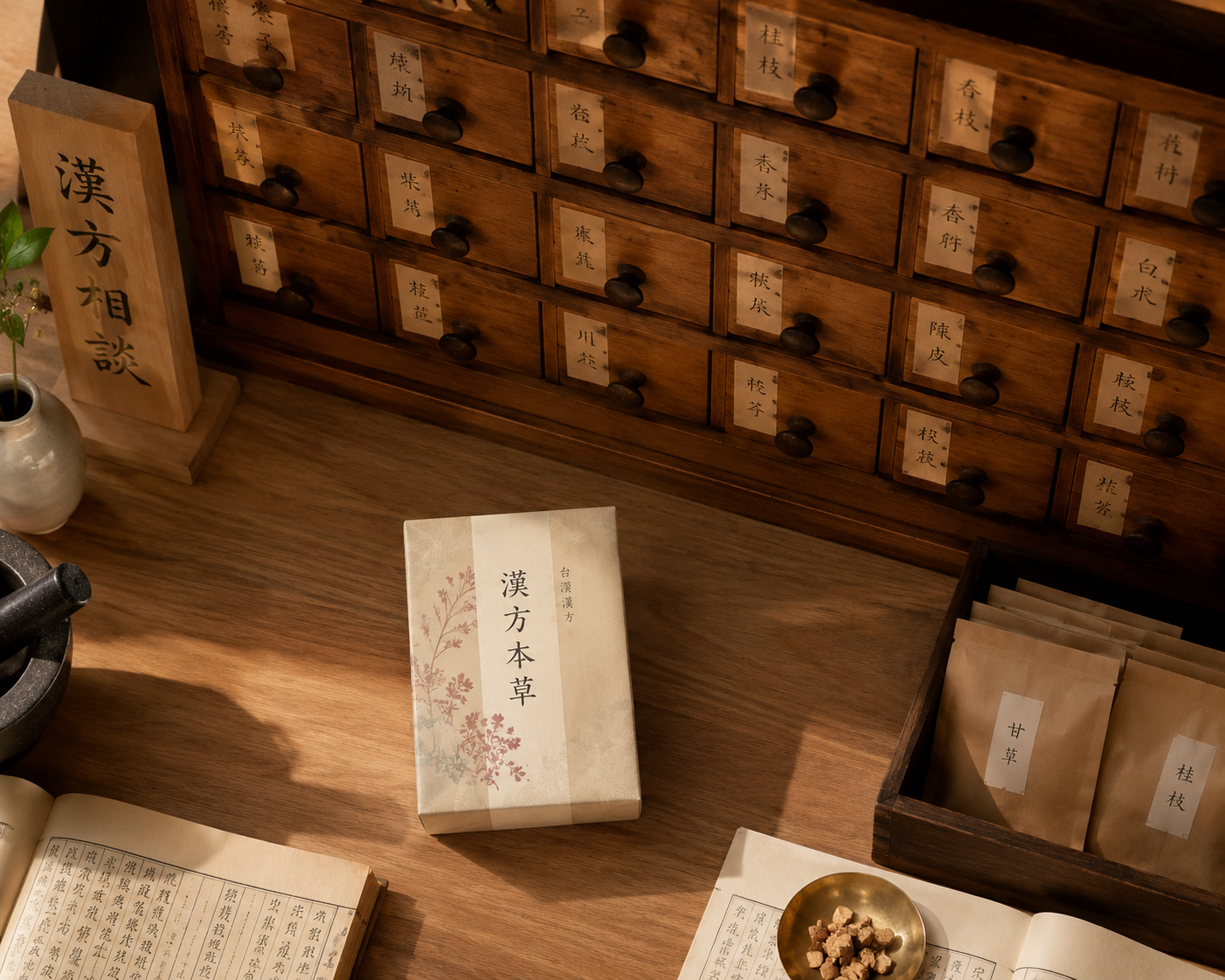
Taiwanese kampo, built on Traditional Chinese Medicine, has developed its own manufacturing discipline, marker-compound standardisation and modern evidence base — establishing a high-quality position in the global traditional-medicine market. Japan's market is layered: kampo pharmacies, drugstore chains, e-commerce, and clinic-linked dispensing, each with its own regulations and trade conventions. The first design question for a Taiwanese brand entering Japan is therefore: which channel do we open with.
This article is grounded in MZ Pharma's day-to-day work in Taiwan–Japan distribution, and lays out a pharmacy-led market-entry path — from OEM/ODM contract manufacturing to channel build-out, with the points you need to know before the first business meeting.
01Reading the Japanese market
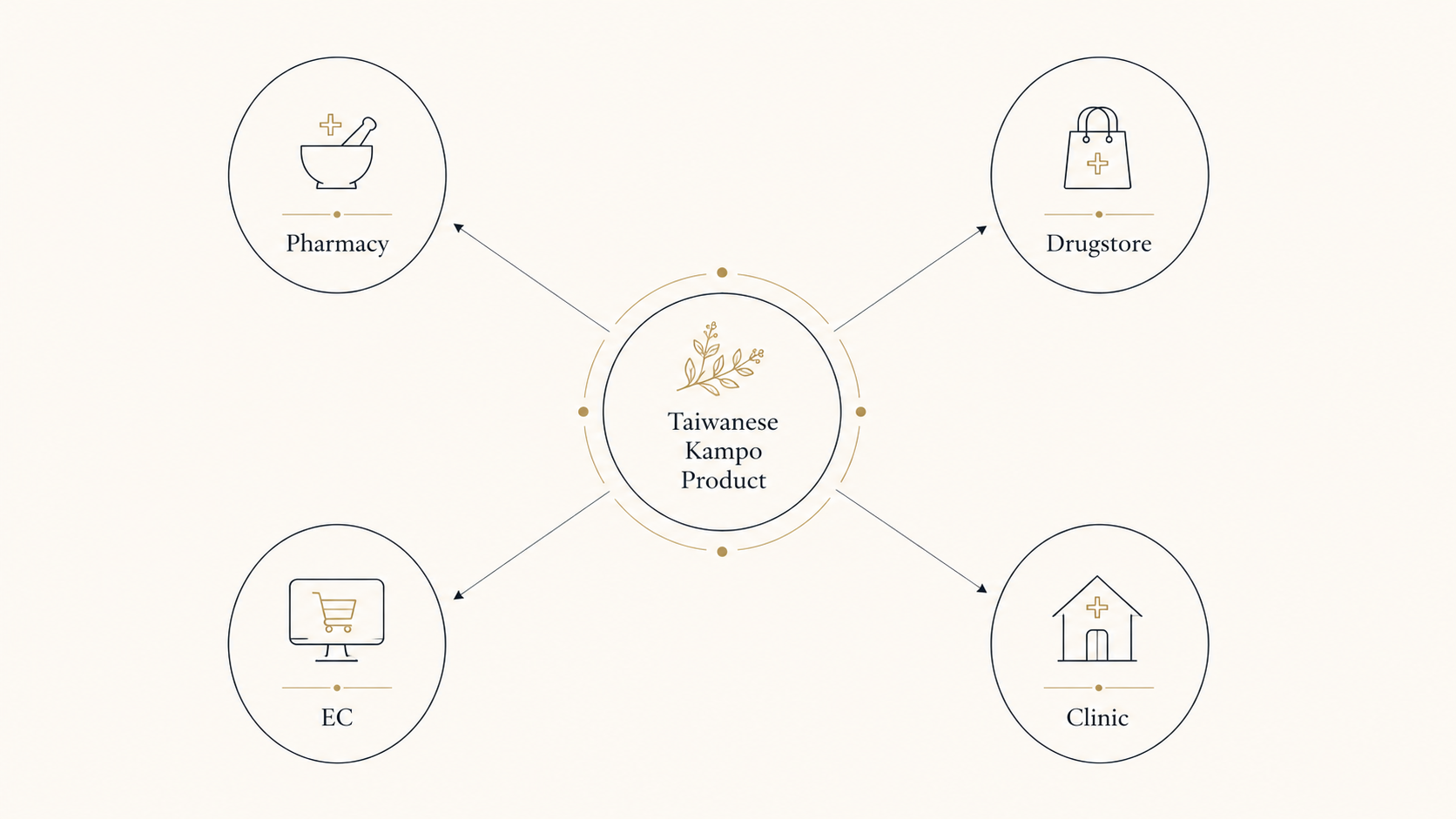
Japan's wellness distribution has four layers: (1) kampo and traditional pharmacies, (2) drugstore chains, (3) mail-order and e-commerce, (4) clinic-linked dispensing. Taiwanese brands enter most easily through (1) — pharmacies that value quality and story — and (3) — e-commerce, which has room for niche categories. Large drugstore chains decide listings off POS data and turn velocity; new brands face high barriers there.
Most kampo-pharmacy owners are pharmacists or registered sellers. They curate by "explainability of ingredients", "manufacturing background" and "philosophy of the formulation", with price coming second. Taiwanese kampo's strengths — provenance and prescription rationale — are exactly what this channel rewards.
02Regulation & imports: food or pharmaceutical?
The first decision at import is the product category. Same crude-drug origin, different category — and the eligible pharmacies, allowed claims and required documentation all change.
Food import (health food / Foods with Function Claims)
Most Taiwanese kampo drinks, powders and patches are imported as "food", governed by the Food Sanitation Act. They cannot bear medicinal claims, but once registered as Foods with Function Claims (FFC) they can carry messages such as "helps maintain knee-joint health". The Taiwan-side marker-compound data must be re-evaluated on the Japan side, and a structured systematic review of safety and function compiled.
Quasi-drug / cosmetic routes
Patches and creams may go via cosmetic notification or quasi-drug approval. The cosmetic route can ship in roughly six months; quasi-drug takes 12–18 months but unlocks claims like "stiff shoulders" and "lower-back pain".
Plants such as Ajuga decumbens, reishi, cinnamon bark and goji are food-distributable in Taiwan and, under Japan's drug/food classification notice, can in principle move as foods. But once any "Annex 1" (pharmaceutical-only) ingredient is mixed in, the food classification breaks. Scrubbing the raw-material list is step zero.
03Working the pharmacy channel: how to get listed
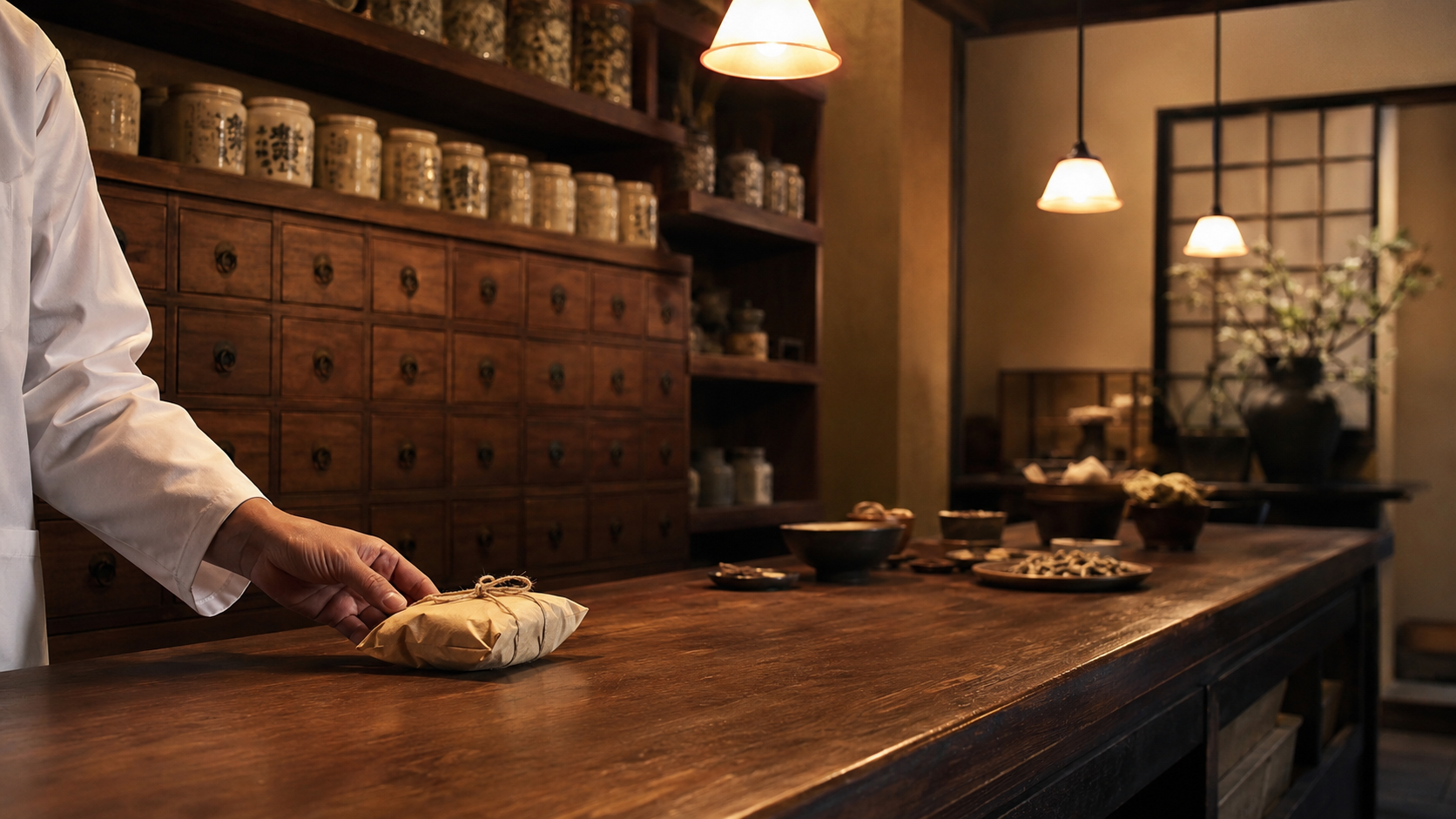
Japanese kampo pharmacies come in three shapes: independents, chains, and dispensing co-located with clinics. Onboarding a new brand depends on building trust with the owner — a conversation-driven sales motion. Trade shows, academic meetings and regional pharmacist-association events are the entry points.
- Phase 1: seeding (month 1–3) — sample with 5–10 independent pharmacies; let owners try and judge for themselves.
- Phase 2: building proof (month 4–9) — collect sell-through data and customer feedback into case decks and sales material.
- Phase 3: lateral expansion (month 10–18) — pitch to regional pharmacist associations and kampo-pharmacy alliances; aim for multi-store onboarding.
- Phase 4: chain rollout (month 18+) — open conversations with chain HQs, with full-year sales data as your leverage.
04Pricing & in-store scripts
Convert your Taiwan domestic price straight into yen and you will be too expensive. Japanese consumers compare implicitly on "yen per gram of active" and "yen per daily dose".
The reasonable band sits at 80–120% of comparable Japanese product. Below the floor the quality is doubted; above the ceiling you need story to support it.
Taiwanese kampo justifies its price through provenance and story. "Forty years of accumulated formulation", "marker-compound standardisation", and "Japan-side CDMO refilling" — those three sentences are the spine the owner can tell the customer.— MZ Pharma / Distribution
Designing the sales script
To reduce the owner's cognitive load on the floor, ship every delivery with a one-page card: 30-second answers to the three questions every customer asks — "What's the difference?", "How do I take it?", "Any side effects?". When the owner can answer fast, recommendation rates climb.
05Our roadmap: 100 pharmacies in 18 months
MZ Pharma's standard is 18 months, 100 stores for a Taiwanese brand entering Japan.
- Month 1–2 — legal/regulatory category fix, import route selection, first sample run
- Month 3–4 — Japan-side CDMO matching, Japanese-language label and collateral
- Month 5–9 — onboarding 15 lead pharmacies and gathering sell-through data
- Month 10–14 — lateral push through regional pharmacist associations and trade shows; expand to 50 stores
- Month 15–18 — chain HQ conversations; reach the 100-store milestone
Scale, category and brand stage shift the details, but the 18-month skeleton holds.
You can talk to us at the concept stage. After NDA, we deliver a first-pass proposal with Japan-market competitor analysis, price band and recommended path. → Contact form